Built by Nick Mermiges, Esq., founder of PLI Labs · proprietarylegal.ai
Published 2026-11-18. This page is the front of PLI Labs’ Volta research repository. Every number on it is labelled MEASURED (on our hardware, with its conditions), UPSTREAM (someone else’s, linked) or ESTIMATE (arithmetic), and links to its source. The failures are told as plainly as the wins.
This is the long read at the front of PLI Labs’ Volta research. It explains the Tesla V100’s architecture and how it compares with newer chips, how the 1Cat-vLLM community made it serve current models, every speed optimization we made in four builds of DeepSeek-V4.1-Flash on eight and twelve V100s (with the ones that lost), how each was tested, when each is likely to apply to another machine, how to write a kernel for this chip, and what the hardware costs, gives and takes, with a parts list.
Contents
| Section | What is in it |
|---|---|
| The four builds in numbers | tok/s for decode, prefill and concurrent requests, the KV cache, figures at 128K of context |
| What you can use from this page | the six points to take away |
| Part 1: Volta’s architecture | FP16-only tensor cores, fast HBM2, NVLink inside a board, PCIe between boards |
| Part 2: How it compares with newer chips | what each generation added, and what a 4-bit format buys on a card with no 4-bit hardware |
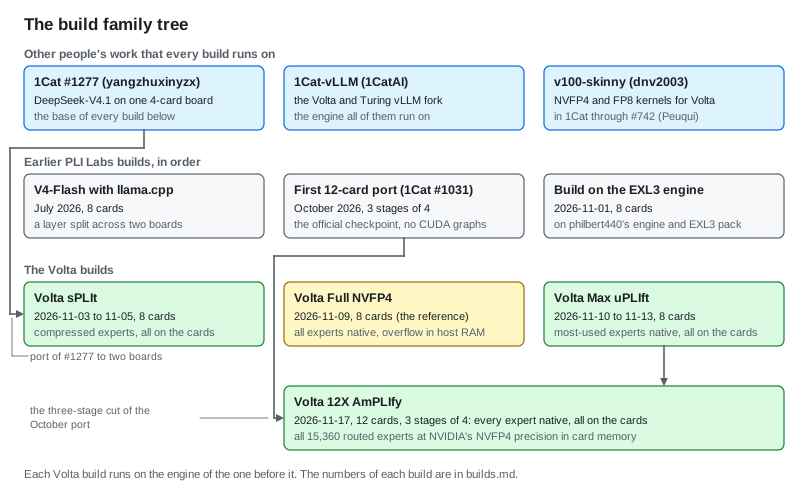
| Part 3: How it was made to work under 1Cat-vLLM | who built what; pipeline stages of tensor-parallel cards |
| Part 4: Every optimization, build by build | one table per build: what it gave, what it cost, whether it changes answers; the losers too |
| Part 5: The whole process of testing | rules before data, fenced windows, two judges, what went wrong |
| Part 6: When an optimization is likely to apply | a decision table keyed on your cards, your context and your requests |
| Part 7: How to build a custom kernel for sm_70 | sizing, the order of attack, the numerics contract, what does not port |
| Part 8: The hardware, what it costs and what it gives | prices, power, drawbacks in the founder’s own words; the hardware list |
| Part 9: The builder skill | the method packaged for coding agents |
| Part 10: Every final build and every source | links |
The four builds in numbers
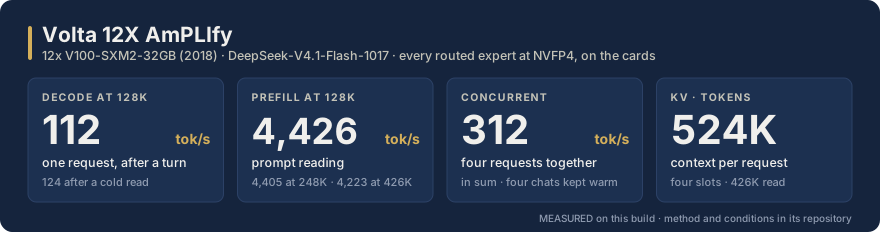
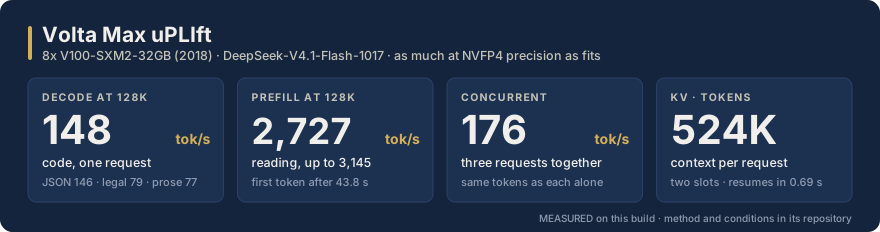
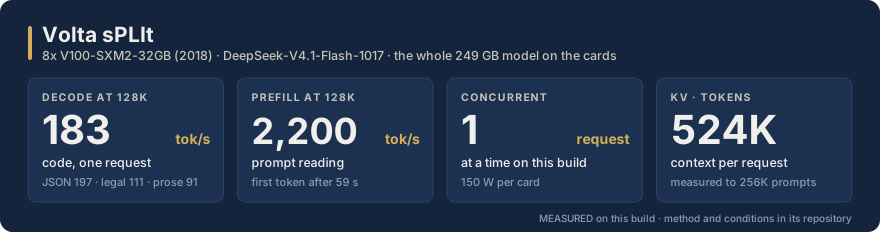
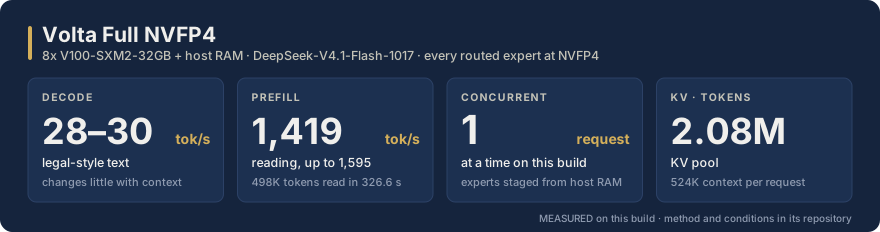
Each card is one build on its own hardware, measured under its own conditions, and links to that build’s repository. The conditions, the context and KV cache figures and the accuracy of each are in builds.md.
What you can use from this page
A Tesla V100 is a datacenter GPU from 2017. Four of them on an NVLink board hold 128 GB of fast memory and cost about $2,400 used when we bought ours (part 8). This page is what under three weeks of work on eight and then twelve of them taught us, with DeepSeek-V4.1-Flash-1017, a 40-layer mixture-of-experts model, on hardware bought from February 2026 and after months of serving smaller models on it:
- It works, and it is fast enough to use. On eight cards, MEASURED 2026-11-05: at 128K tokens of context, 183 tok/s writing code and 111 tok/s writing legal text; 2,200 tok/s reading the prompt; 524K tokens of context per request (Volta sPLIt). On twelve cards, every expert at NVFP4 precision: 128 tok/s for one request and 3,833 tok/s reading a 93K prompt (Volta 12X AmPLIfy).
- Most of that speed is other people’s work, chiefly the 1Cat-vLLM fork and the v100-skinny kernels. Part 3 says who did what.
- The card is never short of arithmetic when it writes. It is short of memory bandwidth and it loses time between kernels. Every optimization that won follows from that (part 1).
- The largest gains were not kernels. A cache that survives a changed reply (0.69 s in place of 31 s), one transport setting (-14 % to the first token), not re-sending a request’s history every step (-25 % of a round at 128K).
- More than thirty ideas lost, some of them faster than what we kept. They are all listed with their numbers (what did not work).
- The method is the reusable part: a rule written before its data, a reference measured in the same hour, and a judge that cannot be talked into a pass (part 5).
The four builds, with links and headline numbers, are in builds.md. If you only want to know whether an idea applies to your machine, go to the decision table.
Part 1: Volta’s architecture
The V100-SXM2-32GB is NVIDIA’s Volta generation, compute capability 7.0, called sm_70 by the compiler. Four
facts about it decide everything below.
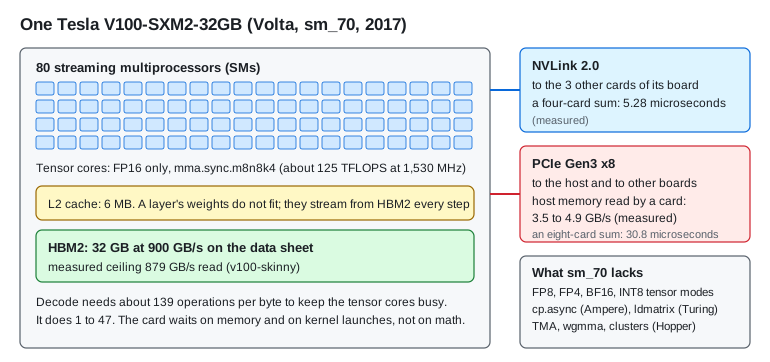
1. Its tensor cores do one thing. Volta introduced tensor cores, and its only tensor instruction is
mma.sync.m8n8k4: half-precision (FP16) inputs, FP16 or FP32 accumulation. There is no FP8, FP4, BF16 or INT8
tensor path. Two helper instructions that every later fast kernel leans on are missing too: ldmatrix (Turing) and
cp.async (Ampere). Source: NVIDIA’s Volta tuning guide
and the later guides for what was added. A kernel written for a newer chip does not port. Its idea might.
2. Its memory is fast, and that is the number that matters. 32 GB of HBM2 at 900 GB/s on the data sheet; 879 GB/s read, measured (UPSTREAM, v100-skinny). The FP16 tensor cores give about 125 TFLOPS at the full 1,530 MHz clock (Volta whitepaper). Divide one by the other: the card must do about 139 floating-point operations per byte it reads to keep its tensor cores busy.
3. Writing a token does almost no arithmetic per byte. To write one token the model multiplies each weight matrix by one row, or by six rows when a drafter proposes five tokens ahead. That is about 1 operation per byte for FP16 weights and at most about 47 for 2-bit weights at six rows (arithmetic). All of it is far below 139. So in decode the tensor cores wait. Time is bytes read divided by bandwidth, plus fixed costs: about 2,089 kernel launches per round on the eight-card build, and the gaps between them (MEASURED by profile, 2026-11-03, research note). Reading a prompt is the opposite case: thousands of rows at once, plenty of arithmetic per byte, and tensor-core kernels pay.
4. The cards are joined by two very different wires. Four cards share an SXM2 board with an NVLink 2.0 mesh. Boards reach each other, and the host, only through PCIe Gen3. MEASURED on our machines: adding four cards’ partial results takes 5.28 microseconds inside a board and 30.8 across two boards (source); a card reads weights from host memory at 3.5 to 4.9 GB/s (source), about two hundred times slower than it reads its own.
The rule that follows: tensor parallelism inside a board, pipeline parallelism across boards, and nothing a round needs on the far side of PCIe.
Part 2: How it compares with newer chips
Each generation since added an instruction the previous one lacked. The table shows what was added and what it means for a model stored in few bits.
| Generation | Tensor-core arithmetic | Data movement inside a kernel | Low-bit weights |
|---|---|---|---|
Volta V100 (sm_70, 2017) |
mma.sync.m8n8k4, FP16 only |
by hand: global memory to registers to shared memory | none in hardware. Every format is unpacked in software into FP16 operands |
Turing (sm_75) |
larger FP16 tiles; INT8 and INT4 modes; ldmatrix |
by hand | INT8, INT4 |
Ampere A100, RTX 30 (sm_80, sm_86) |
BF16, TF32, INT8; sparse modes | cp.async: asynchronous copies into shared memory |
INT8; no FP8 or FP4 |
Hopper H100 (sm_90) |
warp-group multiplies (wgmma) fed from shared memory |
TMA tile copies; thread-block clusters | FP8 in the tensor cores |
Blackwell B200 (sm_100) |
tcgen05 with its own accumulator memory |
TMA | FP8, FP6, FP4, with block scaling (MXFP4, NVFP4) |
DGX Spark GB10 (sm_121) |
warp-level mma.sync with block-scaled FP4 and FP8; no tcgen05 |
- | FP4 and FP8 in hardware, on 128 GB of unified memory at 273 GB/s |
Sources: NVIDIA’s Volta, Ampere, Hopper and Blackwell tuning guides and the DGX Spark hardware overview; the full table with its references is in our kernel survey.
What a 4-bit format buys on a card with no 4-bit tensor cores. On Blackwell, NVFP4 weights go into the tensor cores as they are. On Volta they cannot. A kernel reads the 4-bit codes, unpacks them in registers into FP16, and multiplies with the one tensor instruction it has. The multiply is no faster. The read is four times smaller, and decode is limited by the read. v100-skinny’s NVFP4 kernel reaches 77 % of the measured read ceiling at one row (UPSTREAM). So “NVFP4 cannot help on a V100” is wrong, and so is “fewer bits are always faster”: unpacking costs instructions per weight, not per bit. Our 2-bit expert kernels read at only 290 to 415 GB/s because they were limited by instructions issued, not by memory (MEASURED, Volta sPLIt).
The comparison that surprised us. One V100 has 3.3 times the memory bandwidth of a whole DGX Spark (900 against 273 GB/s, both published). The Spark has the modern instructions; the old card has the wider road. For a task limited by bytes per second, eight-year-old HBM2 is not obsolete.
Part 3: How it was made to work under 1Cat-vLLM
Upstream vLLM dropped Volta. 1Cat-vLLM, by 1CatAI, is the fork that kept
it: Volta kernels for quantized layers, a Volta attention backend, CUDA graphs on sm_70, speculative decoding,
pipeline parallelism. Everything on this page runs on it. The pieces, and whose they are:
| Piece | What it does | Whose |
|---|---|---|
| The DeepSeek-V4.1 package for one four-card board | The model on sm_70: its kernels, 512K of packed key-value storage, the launcher. A warm decode round of 24.9 ms (UPSTREAM) |
yangzhuxinyzx, #1277 |
| The QPN kernels for NVFP4 and FP8 | 4-bit and 8-bit weights unpacked into FP16 tensor-core operands, with no shared memory in the main loop | Dennis Vertzyas, v100-skinny; packaged into 1Cat by Peuqui, #742 |
| The speculative drafter (DSpark) | A small model proposes five tokens; the big model checks all five in one pass and keeps the ones it agrees with | DeepSeek’s design; the 1Cat verifier by yangzhuxinyzx, #274 |
| The EXL3 engine for this model | EXL3 experts, attention inside CUDA graphs, the drafter, a 1M-token context. Our first eight-card build ran on it | rivetphilbot, #1243; published by Phil Tompkins as deepseek-v4.1-v100 |
| Synchronous scheduling | Turning asynchronous scheduling off gave +55 % decode on a two-stage V100 build (UPSTREAM) | zambalee, issue #852 |
| The first run of the official checkpoint on twelve and on eight V100s | Three stages of four, or two; the legal stage cuts. About 3 tok/s (UPSTREAM) | PLI Labs, #1031 |
| The port of #1277 to two boards, and then to three | Below | PLI Labs |
The layout. The model has 40 layers. A board holds four cards in tensor parallel: each card has a quarter of every matrix and the four add their partial results after every layer, over NVLink. That is one stage. The layers are cut into two stages on eight cards, or three on twelve, and only the hand-off from one stage to the next crosses PCIe.
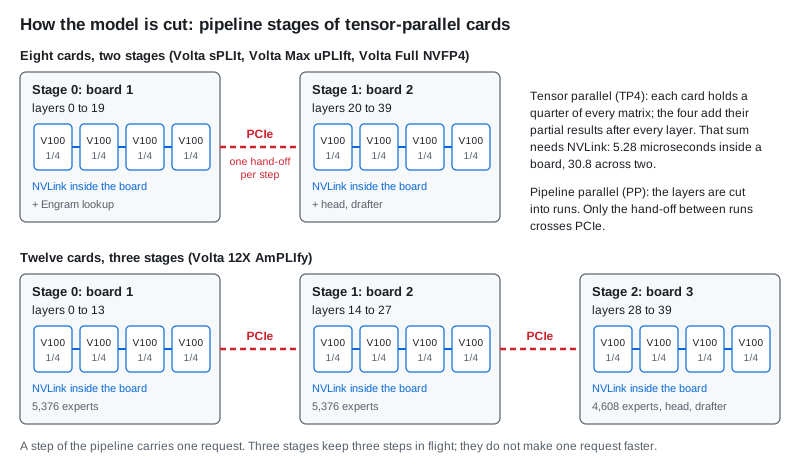
Not every cut is legal. The model’s sparse attention reads from a few “source” layers, and a stage must begin at one. With the memory of a card as the second constraint, that leaves layer 20 for two stages and layers 14 and 28 for three.
What the port was. #1277 serves this model on one board by keeping a third of the experts in host memory. On fresh text it then ran at 25 tok/s against 97 warm, because of the fetches (MEASURED on one of our boards, source). Putting the second half of the model on a second board means no expert is ever fetched. That is Volta sPLIt: 99 tok/s on the day of the port, before any optimization.
Long context comes from the model and the package: packed key-value storage with a ring of recent positions on the cards and the rest in host memory; prompts read in chunks of 8,192 tokens; a prefix cache. We measured needle retrieval at 450K and 498K tokens: 6 of 6 in 4 of 4 runs.
Every credit, with each pull request’s author and state checked on 2026-11-18, is in CREDITS.md.
Part 4: Every optimization, build by build
One short table per build here; the full tables, with every loser, are linked from each heading. “Answers” says whether the change can alter the model’s output: bitwise (same bits), near-tie (may differ only where two tokens were almost tied; gated), rounding (a different but equally valid rounding, judged by closeness) or changes (it does, and the row says what was done about it).
Volta sPLIt (eight cards, compressed experts) · full table
MEASURED 2026-11-03 to 11-05, 150 W per card, clock ceiling 1,522 MHz, milliseconds per verify round in mirrored A/B arms. The plain port: 31.1 ms per round. The checkpoint: about 23.1 ms (ESTIMATE from the measured 23.2 to 23.4 and one further measured change).
| Optimization | Gave | Cost | Answers |
|---|---|---|---|
| Model Runner V2 (vLLM’s newer runner, our port for this model) | -2.76 ms per round | 1.4 ms slower at one prompt length (32K), cause unknown | bitwise |
| Expert kernels: fast variants, then an “instruction diet” | -1.2 to -1.7 ms, then -0.87 ms | none | bitwise; the diet near-tie |
| Add the index only over the live context, not the maximum | -0.85 ms | none | exact |
| Keep the request in the batch across empty pipeline steps (port of Peuqui’s #1263) | -24.8 % of a round at 128K | none | identical |
| Coupled sampled drafts (the idea is TensorFold #25) | +14 % tok/s at temperature 1 | 0.3 ms per round | exact in distribution |
| Prefill skip: early prompt chunks skip layers they cannot reach | first token -8.8 % at 32K, -31.5 % at 300K | none | identical |
| Host hand-off between the boards (one NCCL setting) | first token -13 to -14 % | none | bitwise |
| Tiled and fused index scorers | decode -13.7 % at 300K; first token -9.5 % at 300K | none | bitwise; the fused one near-tie |
| Three chat slots, for their caches | chats taking turns: first token 20 to 49 s down to 0.6 to 0.9 s | card memory | identical |
| Lost: fused prefill attention | first token -11.4 % | not installed | changes: a confident token moved |
| Lost: asynchronous scheduling; one tensor-parallel group of eight; 19 expert-kernel variants | +1.68 ms; 30.8 against 5.28 microseconds per sum; none faster | - | - |
Volta Full NVFP4 (eight cards, every expert native, overflow in host RAM) · full table
MEASURED 2026-11-09, clock ceiling 1,522 MHz.
| Item | Result | Answers |
|---|---|---|
| Folding NVIDIA’s NVFP4 pack to MXFP4 | 44,696,862,720 values bit-equal | exact |
| Experts split between the cards and host RAM | bit-equal to all on one card | exact |
| Per-stage card reserves from sampled peaks | a 498,099-token prompt reads in 326.6 s with no out-of-memory error | - |
| Lost: reading experts from host RAM in decode | about 975 microseconds per expert per layer; the build decodes at 28 to 30 tok/s on legal-style text | - |
This build exists to give an all-NVFP4 output to check other work against. Its lesson is the number in the last row.
Volta Max uPLIft (eight cards, the most-used experts native) · full table
MEASURED 2026-11-09 to 11-13; the clock ceiling and power limit changed between test windows, so compare inside a row.
| Optimization | Gave | Cost | Answers |
|---|---|---|---|
| Promote experts to native precision in order of use per byte, all on the cards | 6,087 of 15,360 experts native; 79 to 85 % of decode routes on them; the same next token as NVIDIA’s NVFP4 pack on 95.1 % of compared tokens | card memory: every slot and every reserve costs native experts | rounding: measured by a preregistered closeness test |
| No host tier at all | general text 58 to 59 ms per round down to 33.4 | - | - |
| Group-plan kernel (one launch in place of a chain of tensor operations) | -4.9 ms per round | none | bitwise |
| Snapshot of the sliding-window state per slot | a follow-up after a changed reply: 0.69 s in place of 31 s at 100K | 82 MB of host memory | identical to an ordinary cache hit |
| Prompt slots (two by default) | two together 158.7 tok/s (1.33 times one stream); three together 176.2 (1.48 times) | 267 to 553 fewer native experts; quality not established | identical to the same prompt alone |
| Fast prompt reading from compressed records | first read near 200K: 86 to 119 s where native reading took 155 to 165 s | changes output from the first token; quality not established | changes |
| Lost: a new decode kernel; 64 rows per weight load; a remote drafter | 0.000 ms predicted; slower; 42.6 ms per round against a 4.5 ms bar | - | - |
Volta 12X AmPLIfy (twelve cards, every expert native, all on the cards) · full table
MEASURED 2026-11-17 and early 2026-11-18 on a twelve-V100 server, 150 W per card unless the row says 200 W, clock ceiling 1,477 MHz (source).
| Change | Gave | Cost | Answers |
|---|---|---|---|
| A third pipeline stage on the fast engine | every one of the 15,360 routed experts at NVFP4 precision in card memory; first divergence from an all-native reference after a median of 208 tokens | a third stage does not make one request faster: 128 tok/s | rounding: measured by closeness |
| Scheduler spacing for three stages | without it 15 of 15 answers were wrong | none | it is a correctness fix |
| Prompt chunks of 4,092 rows | room for a third and fourth slot | prefill 4 % slower | rounding |
| Four slots | four chats kept warm; three together 288.0 tok/s summed, four together 306.6 (242.6 by wall clock) | a fourth request adds only 6 %: a pipeline step carries one request | identical |
| 200 W in place of 150 W | prefill +13.7 % (3,284 to 3,733 tok/s) | power; decode unchanged | none |
| Release the allocator’s cache only above the chunk size (tested, not yet serving) | prefill +12.6 % at 61K, +9.9 % at 93K (200 W, one boot) | none found | identical |
| A conversation store: a chat’s state saved to disk (tested, not yet serving) | a 131,466-token turn back after a restart in 1.23 s where a cold read took 43.84 s | - | not token-identical to a cold read |
| Lost: one stage on the same eight cards with no pipeline (one test window) | one request -3 %, three at once -41 %, long reads -26 % | - | - |
Earlier builds · full page
DeepSeek-V4-Flash with llama.cpp (July 2026) found a silent corruption with quantized key caches and that fourteen cards in a layer split are half as fast as eight. The first twelve-card port (October) found the legal cuts and ran at 3 tok/s. The EXL3 engine build (1 November) found that keeping the Engram tables in RAM cut a cold first token from 46 to 27 s.
Part 5: The whole process of testing
The full method, as a reusable document, is method/testing.md. In brief:
- A rule is written before its data. The arms, the figure that decides, the noise floor, and what counts as accept, as no measurable change, and as inconclusive. It is time-stamped and not edited afterwards.
- Predictions are recorded and scored. A wrong prediction stays in the record as wrong.
- INCONCLUSIVE is never a pass. “Could not check” and “found nothing wrong” are different results.
- The unit is the verify round, not tokens per second, because tokens per second moves with the text.
- Mirrored arms and a measured noise floor. OFF, ON, ON, OFF, each arm a fresh boot; the same configuration measured against itself sets the floor.
- A fenced window on a machine that also serves. The serving build stops; the reference boots in the same window; one change per boot; the serving build is restored and checked.
- Two judges. The identity judge (token ids equal to a same-window reference) for changes that claim the same arithmetic. The closeness judge (same next token, KL divergence, changed multiple-choice answers, against a reference that is itself run twice) for changes that alter rounding. Identity cannot show answers are good. Closeness cannot show closeness to the original model if the reference is a quantization.
- Checks run on real logs before a window.
The other half of the method: do not test forever. The rules above apply where a result is claimed; they are not a reason to circle. Launch the proven upstream recipe first: in September a hand-built runtime decoded at 1.13 tok/s after days of testing, and the upstream recipe gave about 49 on the same cards that week. Read upstream before planning: one plan assumed a 4-bit format could not help on Volta while v100-skinny already ran it at 77 % of the read ceiling. And a test exists to decide something (the long form).
What went wrong. These are the most useful paragraphs on the page.
- Our own checks spoiled test arms five times on one build. A pattern for out-of-memory lines matched the memory limit’s own announcement and refused a good boot. A worker count was doubled by a new log line. A witness read a process environment that the engine blanks. A probe replayed answers without their reasoning and measured cold reads. A witness failed a boot on a harmless warning. Each had passed its own tests. None had been run against a real log of the boot it would judge.
- The equality judge accepted cut-off answers. It compared two answers only as far as the shorter one. Removing a token from each of twelve references still printed “identical 12 of 12”.
- A cache returned wrong tokens after an edit. A token cache under construction returned wrong ids on a hit when an edit removed the special token at its cut. Its check compared token counts, which matched.
- Isolated kernel benchmarks were wrong in both directions. One predicted 0.03 ms for a change that gave 0.42.
- A cached answer is not a cold answer. On the unmodified engine, a reply after a cache hit can differ from a cold read of the same prompt at near-tied tokens. A test that assumes otherwise fails correct code.
- A slowdown its user caught first. On 2026-11-06 one-stream decode on the serving build fell from about 130 tok/s to about 21, and it was the person using it who noticed, not the campaign’s checks. Use stopped until it was measured fixed. A serving build needs a speed check that runs without being asked.
- A sum is not a rate. “Four requests: 306.6 tok/s” was a sum of four rates. By wall clock it was 242.6.
What an independent review found. After the twelve-card build was serving, a second model was given the whole record, read-only, and one question: what did we measure wrong? The cut-off judge, the token cache and the sum-against-rate are its findings. It also showed that a time-budget finding was overstated by a factor of two; the prediction was corrected before the test ran, and the test then matched the corrected figure (+9.9 %, where up to about 9 % was predicted). The review worked because it could not change anything, and because it was handed receipts, not conclusions.
Part 6: When an optimization is likely to apply
The long form is method/decision-table.md. The short form:
| Your situation | Do this | Expect |
|---|---|---|
| The model fits one four-card board | tensor parallel 4, nothing else | the fast case |
| It needs two or three boards | one pipeline stage per board; never one tensor-parallel group across boards | one hand-off per step over PCIe; a third stage adds capacity, not single-request speed |
| It does not fit the cards at the precision you want | lower the precision of the least-used weights, or add a board. Do not read weights from host RAM in decode | about a millisecond per expert per layer if you do |
| One request at a time | the decode-round levers; synchronous scheduling | 31 ms down to 23 ms per round on our eight cards |
| Several long chats taking turns | one slot per chat, for its cache | seconds, not tens of seconds, to the first token |
| Several requests truly at once | slots up to the number of stages | 1.3 to 1.5 times one stream; little beyond. The aim was high total throughput from several long requests at once; on this engine a pipeline step carries one request, so the gain stops at the number of stages. Batched decode inside a step exists upstream (#1482) and is not in these builds |
| Prompts over 32K | keep-batch, the prefill skip, the transport setting, live-context index scoring | first token -9 to -31 %; decode round -10 to -25 % |
| A chat whose earlier turns come back slightly changed | snapshot the window state; keep system notes in place | 0.5 to 0.7 s in place of 11 to 31 s |
| Answers must be bit-identical | only the rows marked bitwise, exact or identical | you give up about 0.9 ms per round and part of the prompt-reading gain |
| Prose, not code | nothing here helps much: the drafter accepts 1 of 5 tokens on prose and 4 of 5 on code | 90 against 215 tok/s on the same engine |
Part 7: How to build a custom kernel for sm_70
The guide is method/kernel-building.md; the rules it distils, with sources, are in research/kernels/. The order:
- Size it first. Time cannot be less than bytes read divided by about 720 GB/s, or operations divided by 125 TFLOPS. Convert the saving to milliseconds per round. Under about 0.3 ms it cannot be measured in the server; do not spend a test on it.
- Attack in order: remove work sized by capacity instead of live data; then cut launches and the gaps between them; only then cut bytes. Never add chains of small operations per layer: one attempt cost 6.9 ms per round.
- Write the numerics contract before the kernel: bitwise if the order of every sum is kept, otherwise a stated tolerance and the near-tie gate. An autotuned configuration is a numerics change.
- Put it behind a switch that defaults off, and prove that off means the old code.
- Test like an adversary: every row count the server will send, outputs into NaN-filled buffers,
compute-sanitizer, a deliberately broken kernel to confirm the test fails. - Let only the end-to-end A/B decide.
What does not port from Ampere or Hopper: anything built on cp.async, ldmatrix, larger tensor-core tiles, FP8
or FP4 tensor modes, tile copies or warp-group multiplies. That includes FlashAttention-2 and later, Marlin, and
the FP8 and FP4 GEMM libraries. On Volta the pipeline is staged through registers by hand and the fragments are
loaded by hand. Pin CUDA 12: CUDA 13.0 removed Volta.
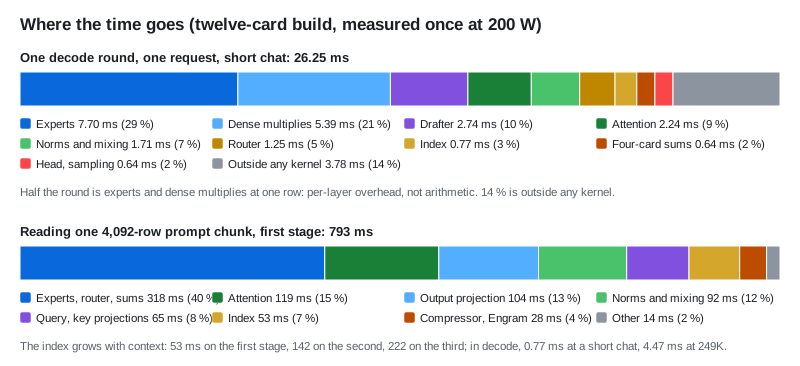
The figure is why the order above is the order. Half of a decode round is expert and dense multiplies at one row: overhead per layer, not arithmetic. One seventh is outside any kernel.
Part 8: The hardware, what it costs and what it gives
The parts list, with a link for every part, rough prices, the steps to build it, cooling options and photos, is its own page: the hardware list. This part is the argument for and against, mostly in the founder’s own public words.
The idea. From his post of March 2026:
Buy 4 32gb v100 sxm cards/heatsinks for 1600, get the aom sxm board and pex card for 750. That’s 128gb of unified nvlink vram for 2400.
and from the hardware update of November 2026:
The core idea, which I’ve been banging on about for a while: SXM2 V100s on 4-card NVLink boards are still the cheapest big pool of fast VRAM I know of.
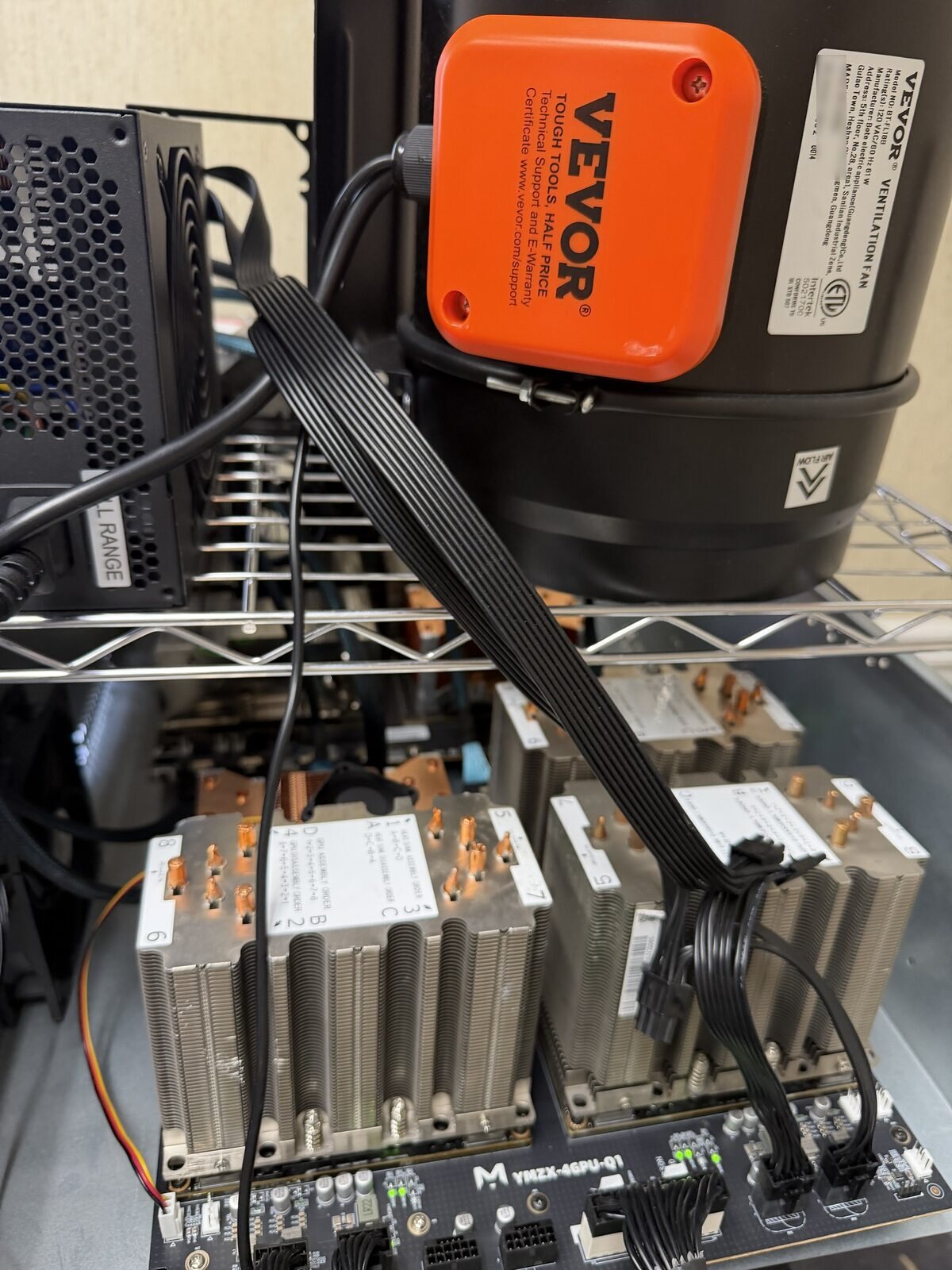
One four-card board: 128 GB, NVLink between the four cards, cooled by a duct fan from above.
What you buy, in short (full list with links):
| Part | For one four-card board | Roughly, used, in 2026 |
|---|---|---|
| Tesla V100-SXM2-32GB modules | 4 | $450 to $700 each during the year; about $900 by November |
| Four-card SXM2 NVLink baseboard | 1 | $800 to $900 |
| PCIe switch card with SlimSAS ports, and SlimSAS cables | 1 or 2 cards, 4 cables | $125 to $220 a card (PCIe 3.0); about $530 for a PCIe 4.0 card that takes two boards |
| Heatsinks, thermal paste | 4 | $50 to $100 each when not sold with the card |
| A power supply with enough PCIe 8-pin cables | 1 | about $75 for a 2,000 W unit |
| A blower or a server chassis | 1 | a duct fan, or about $310 for a 4U chassis |
| A host with a free x16 slot per switch card, and ECC memory | a 12-core workstation CPU and board, about $680 together |
What it cost, and what it costs now. The eight-card machine, in his words in November (comment): “When I built it, about 5k. Maybe 450/v100, 800 per board. Now, probably 9-10k.” Tom’s Hardware, reporting the build on 2026-11-09, found that “used V100 SXM2 32GB cards are now listed on eBay for about $900, more than double the roughly $400 apiece from the post, and listings suggest prices are still climbing” (article). The value argument is weaker than it was in March, and it moves with the used market.
What it gives. 128 GB of card memory per board at 900 GB/s per card, with NVLink between the four. Two boards run a 249 GB model with every expert in card memory at speeds a person can work at; three boards run it with every expert at the precision of NVIDIA’s NVFP4 pack. The data stays in the room.
What it takes. The drawbacks, each from the record:
| Drawback | The fact |
|---|---|
| Power | MEASURED on eight cards at a 150 W cap, from card and CPU counters with no wall meter (his comment of 2026-11-06): “Idle: GPUs 458 W (about 57 W a card, yes it hurts) […] Decode: GPUs about 965 W, CPU about 150 W, so about 1.1 kW”. His bill: “Abt $80/month in power” at $0.16 per kWh. Twelve cards at a 200 W cap are a budget of 2.4 kW for the cards (ARITHMETIC). (An earlier comment of his gave 35 W idle per card; the measurement is later and governs.) |
| Heat | The same kilowatt leaves as heat: “they draw power. And throw off a lot of heat so they need their own room” (comment) |
| Cooling and noise | The modules have no fans. “V100s work, but are less practical in that they require active cooling and a good bit more power” (comment). A blower or a server chassis does it; neither is quiet, and we have no noise measurement to give you (cooling options) |
| Age and the used market | 2018 cards, bought used, at prices that more than doubled in 2026. “One GPU board’s power connection had a burn mark. That board came out of the box. Check your connectors, people.” Two host resets under load before the clocks were capped; a later run of faults that was probably one bad power supply (what goes wrong) |
| No FP8 or FP4 tensor cores | Every low-bit format is unpacked in software (part 2). Prompt reading suffers most: 2,200 to 3,850 tok/s here. On a 27B model, v100-skinny measured prompt reading about four times slower on four V100s than on one RTX 5090, at equal decode speed (UPSTREAM) |
| PCIe and NVLink topology | NVLink only inside a board of four. “v100s are stuck at pcie3. 4 card board max out at x8” (comment). Everything larger is pipeline stages over PCIe, and the layout rules of part 3 are not optional |
| Host memory matters too | “One memory channel threw four uncorrected ECC errors, three of them while loading the model”. The cure was a lower memory speed. The model’s lookup tables alone want 110 GB of RAM, resident |
| Driver and CUDA support are ending | “NVIDIA R580, the last driver branch that still supports Volta. These cards are on borrowed time software-wise and I’ve made peace with that.” CUDA 13.0 removed Volta from its compiler; PyTorch keeps it only in CUDA 12.6 builds (announcement); upstream vLLM dropped it. You will pin versions and live on a fork |
| Your time | The cards and boards date from February 2026. Months of serving smaller models on them came first; then under three weeks of daily work with coding agents (2026-10-30 to 11-17) took DeepSeek-V4.1 from “it runs” to these numbers. The builder skill below exists to shorten that |
Per token, from the same measurement (cards and CPU only, one request at a time): “uncached input is about 0.13 kWh per 1M tokens on 64K-128K prompts […] code at about 200 tok/s is about 1.6 kWh per 1M output tokens, legal writing at about 115 tok/s about 2.7 kWh, prose at about 90 tok/s about 3.5 kWh.” A decode round costs the same energy however many drafted tokens it keeps.
Who it suits. Someone who needs a large open model on their own premises, values memory per dollar over speed per watt, can pin software versions, and serves one or a few users. It does not suit anyone who needs many concurrent users, a quiet room, or a vendor to call. His own second thought, from a comment of May 2026: “If i was starting over I guess maybe I would have gotten two 80gb a100s and an nvlink to start. But these I could buy 2-3 at a time […] I am positive newer architecture is easier and runs better. I wasted money on the way. But I can’t say these were a stupid decision at least.”
Part 9: The builder skill
PLI Volta Builder packages the method on this page as a skill for coding agents:
https://github.com/ProprietaryLegal/pli-volta-builder. It carries the research context and the rules of this
repository, and runs the same campaign in order: read upstream first; do the layout arithmetic; bring up a proven
recipe; build a test harness with strict judges; measure a time budget; test one change per boot under a rule
written before its data; write sm_70 kernels by the kernel guide; ask for an independent review; research the
next lever; publish the losses with the wins. Its automated optimization loop is borrowed, with credit, from the
hill-climbing scripts published at https://github.com/0xsero. It builds nothing a person could not; it keeps an
agent from skipping the steps above.
Part 10: Every final build and every source
The builds (numbers):
- Volta 12X AmPLIfy: twelve cards, every routed expert at NVFP4 precision on the cards.
- Volta Max uPLIft: eight cards, the most-used experts at NVFP4 precision. Hugging Face package.
- Volta sPLIt: eight cards, compressed experts, all on the cards.
- Volta Full NVFP4: eight cards, every expert at NVFP4 precision, the overflow in host RAM.
- Earlier: deepseek-v4-flash-v100, swift-1.5-v100, deepseek-v4.1-v100 (a mirror of Phil Tompkins’ engine), the V100 notes in pli-labs.
- Sister work on two DGX Sparks, a different chip: DGX sPLIce.
In this repository: builds.md · the hardware list · optimizations/ · what did not work · the testing method · the kernel guide · the decision table · the source research · every external source · credits.
Upstream, where the work that matters most lives: 1Cat-vLLM · v100-skinny · vLLM.
Published by PLI Labs, the open research arm of Proprietary Legal Intelligence. Corrections are welcome as issues on this repository.